The Good Thanks
Hey all, it’s a Story and Pictures holiday issue.
Not a history of Thanksgiving, or recipe stuff, not that kind holiday issue, just an issue that I’m getting out within the accepted parameters of the 'holiday weekend.'
Food banks everywhere, churches, community centers, charities, and organizations of all kinds provided millions of holiday meals to all, no questions asked nor demonstration of need required. Just as it should be.
We all have special Thanksgiving stories that span the special memory spectrum, from the dreamy ideal represented in artist/illustrator Norman Rockwell's Freedom From Want cover for the Saturday Evening Post, to Thanksgivings missed, to those never forgotten. I'd say it's even more of an emotional holiday than Christmas.
My childhood Thanksgivings were good, though I don't recall any real specifics, more a jumble of scenes. But I've also got two somewhat out of the norm Thanksgiving memories. My 1987 Thanksgiving was spent in the Sydney Hyatt, staying behind as road manager of the Bad tour in Australia while Michael Jackson, my fellow production managers, band, dancers, and crew went out for a dinner courtesy of the shows' promoter. I didn't mind the solitude on what's accepted as a family-close occasion, and it was trippy to know, even to 'feel,' that our two hotel floors were empty.
It was perhaps the mellowest Thanksgiving I've experienced.
I've recounted the other memory before, a mix of the giving spirit and, um, let's call it awareness, and have included the link to it at the end of this issue.
Onward.
No matter the times in which we live, current lives share a commonality with all past lives and those yet to come: there will be best of times, there will be worst of times. (And our blue marble has spun around the universe enough times that, I believe, more people probably don’t know that phrase’s provenance than do know, so here ya’ go)
It’s been a couple worst of years, but recent events makes best of years seem possible again. One can hope. Silver lining and all that.
In this issue we'll start a little tough and get better as we go:
- A U.S. measles update (words that I shouldn’t have ever had to write in the 21st century)
- An essay about What's in the Sky
- A wide selection of Open Tabs
- Photographs
- The Close and A Link to My Annual Thanksgiving tale
And away we go.
Measles
The number of reported measles infections in the U.S. over the last thirty years was zero.
As of this writing the number of reported measles cases is almost 5,500, and there have been deaths.
A dangerous, highly contagious disease — ELIMINATED from the U.S. — and its resulting unnecessary deaths have a direct connection to fringe-fueled ignorance, misinformation, and misguided beliefs. Why someone without education or qualifications in science, medicine, immunology, or disease — none, zero, nada — and who expresses fringe-fueled ignorance, misinformation, and misguided beliefs, why such a person would be appointed to head an agency that oversees the viral health of a nation would seem, oh…unfathomable.
And yet, since such a person was appointed, almost 5,500 people were infected by a disease that can have lifetime-lasting effects.
Hmm. Thirty years: no measles. Since the above mentioned person has been appointed: 5,500 measles cases.
And for any contrarian who points out that my paragraphs do not include other possible factors that may have influenced the numbers...yeah, other factors besides not being vaccinated may indeed have contributed to this unnecessary resurgence of a disease. Sure.
But, lets find a way to bring home just how big this is:
Federal agency consisting of doctors and scientists with no agendas other than the health of Americans: 10,958 days = 0 measles cases.
Same federal agency led by fringe-fueled unqualified non-doctor who espouses doubts about the medical profession, vaccines, and immunization: 679 days = 5,412 confirmed measles cases.
Unfathomable…and yet here we are.
“…Traffic is light on 101 right now, some slow spots but otherwise clear…The sky, however, is a mess…”
I stepped outside one late evening not too long ago, looked up and caught sight of a satellite, a tiny dot of light moving in a line from one side of the evening’s dome to the other side. A night or two later I stepped outside and within a minute or so witnessed two satellites perpendicular to each other cross each others’ path. And over the next couple of weeks, it seemed I could step out at any time of the evening and within a few minutes see a satellite or two.
Look up often enough at a clear night sky and odds are in your favor that you’ll catch sight of something moving along up there. But, my recent sightings got me to wondering why it ‘seemed’ to be so busy.
I do have some satellite-related experience. For several years in the ‘80s I worked for a company that re-sold satellite transponder time for events, conferences, and meetings. Well before the late 20th century build-out and maturity of the Internet, satellite ad hoc teleconferencing gave organizations and individuals who could afford it a way to create temporary private video networks. Our company would reserve transponder time — the technology on satellites that receives and sends data — then sell that time packaged with any video, audio, and other production needs requested to produce or enhance an event, or create a private network.
Our crews and independent technicians did the uplinks (send the data) and downlinks (receive and distribute the data) areas with mobile satellite trucks (note here that 'data' includes video and audio) . It was all pretty cool and the company did all sorts of one-of-a-kind events, trade shows, events with multiple locations, and big stuff like the Los Angeles Olympics.
The beginnings of my forty-plus years of creative services included with many scientific, medical, and communications technology companies (my time in the Army had also included some technical education needed for a particular job). In the earliest post-touring days, even as I still did some concert video work, I landed corporate video scriptwriting gigs, which always required more than a basic understanding of what the hell I was concocting stories about.
I had a several-years gig with what was then PacTel, the paging technology arm of Pacific Telesis, California's phone network and technology provider, which at one point siphoned me away to produce one of its shareholder meetings. During my timer there PacTel then became AirTouch, one of the country's earliest cell phone network and technology developers. Working in telecomm was an education in everything from radio wave basics to the physics of light, to the commercial use of space. All pretty cool stuff, especially during the period that introduced the concept of low earth orbit (LEO) satellites as an integral part of a telecom network. (Which, coincidentally, was the subject of a New York Times article a few days ago.)
So, point is, I’ve been looking up for a long time and, hence, my wondering about a perceived uptick in satellite traffic. Which then became a ‘well let’s sort out accurate observation vs possible perception.’
Turns out that yep, just like, well, everything, change happens. But the increase in how much stuff we’ve sent up there, and how much of it still orbits around is, um, let’s use the word staggering.
A couple of Google queries returned these numbers:
Depending on how "placed in orbit" is measured, the number of satellites between 1999 and late 2026 has increased by roughly 620% to over 3,300%. Only 127 satellites were launched into orbit during all of 1999.
Comparing the number of satellites placed into orbit within a single calendar year shows the sharpest growth, driven largely by commercial mega-constellations like Starlink. In 2025, a record 4,323 to 4,526 payloads reached orbit, and over 3,535 active satellites have already been deployed in 2026 through mid-November.
Percentage Increase. Comparing 1999 to the last full year (2025) represents an increase of approximately 3,304% to 3,464% (roughly 34 to 35 times higher). Even the partial 2026 launch count already exceeds 1999's full-year total by 2,684%.
Tracking catalogs such as Orbital Radar and Jonathan's Space Report record between 19,738 and 20,335 total payloads currently in Earth orbit. Many of the 2,739 satellites in orbit in 1999 were defunct spacecraft. Comparing only working, operational satellites highlights how much active orbital infrastructure has expanded.
Roughly 769 active satellites were operating in orbit around 1999–2000. As of November 2026, between 16,711 and 17,247 active satellites are currently operating around Earth, with SpaceX's Starlink accounting for roughly two-thirds of the active fleet.
Percentage Increase. The active satellite population has grown by approximately 2,143% (more than 22 times the 1999 figure).
Whew.
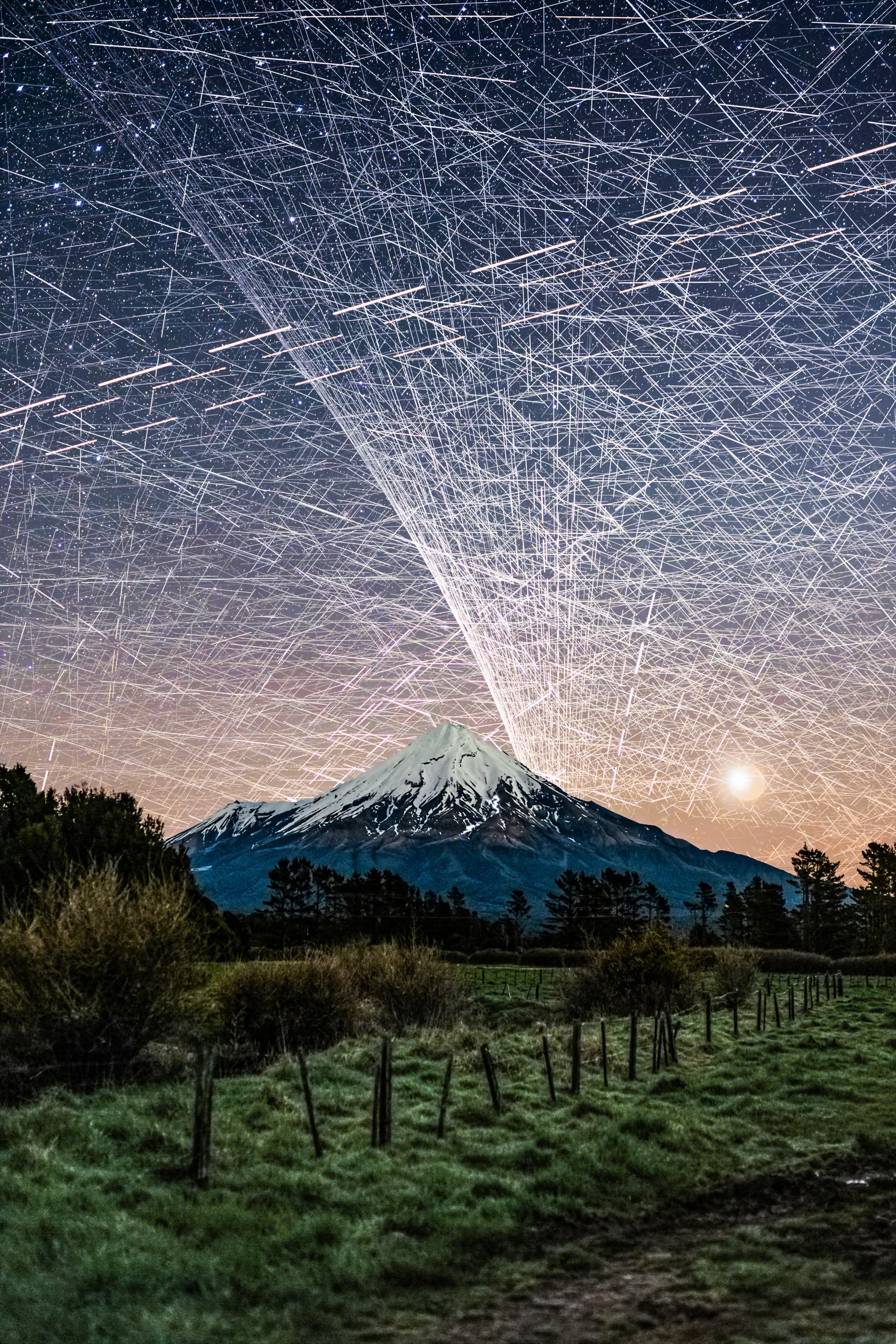
Then, whilst researching all this, comes a related story which is where I’ll (finally) leave this for y’all to explore on your own. Most of the world’s population has neither the time nor inclination to know what’s streaking over its heads, but for those of us who do have the time, inclination, and curiosity, there's New Zealand astrophotographer Brendan Larsen’s image. It shows the sky inundated with about 1,400 satellites and 14,000 trails forming a dense crisscrossing pattern above Mount Taranaki. The story’s photo starkly illustrates what those satellite numbers look like (and the photo ain't AI). The photo below is a link, and in testing it's taken a few seconds to load, so if no photo below to marvel at, give it a few seconds and it should show up:
Open Tabs
A plethora of notable things, in no particular order...
Women rule! You might already know that, but betcha didn't know that without a woman's superbrainiac-ness, no moon landing
Hmm, how appropriate for these times – what liars say
And in this day and age, everyone should be backing up their stuff, and by that I mean, y'know, in case someone in power attempts to erase the history of, oh, say January 6
Coming soon: get your flu shot, get your Covid shot…get your cancer prevention shot
Here's how the baseball umpire who never gets it wrong works.
Ummm...those foundational facts and truths we (some of us) learned in school? Yeah, not quite.
"Got any weed?"
"Yeah, but it's a little old."
"How old?"
"About 2,800 years."
-- A short editorial interlude: this Open Tab is slightly political because it involves politicians, but that shouldn't stop you from checking it out because it's about the coming restoration of a slight to every cop of any form who had to deal with January 6 rioters.
This last Open Tab is a feel good thing, an example of the huge emotional uplift generated by a tiny bit of effort, which leads me to The Close...
The Close
The Good Thanks comes with a brief, somewhat selfish feeling. It's the thanks we get from someone who appreciates something we've done, whether it's holding the door open for someone or serving food at a free meal event. Whether it only takes a moment, a day, or a year, The Good Thanks comes to you when you've done something for someone you don't know or spent time on something that will benefit someone else. When it comes, you can feel really, really good for a little while about why it came to you, understand a little more about yourself, and a lot more about our existence.
I have been gifted The Good Thanks, and I'm grateful not only for having it expressed to me, but for knowing what I did may have helped at least one soul somewhere. I've written previously about one of those something for someone else times, and I feel okay sharing it once a year. You'll find 'A Holiday Whack Upside the Head' here.
Be blessed and thanked, y'all, feel free to share this latest with friends, stay safe, well, and happy.
MWH